Portuguese Naming Traditions: Surnames, Given Names and Family Clues
Portuguese names can be confusing for genealogists because children did not always inherit surnames in a fixed or predictable way. A person’s name might also change after migration or immigration.
There Is No Simple One-Surname Rule
Portuguese families could use surnames from the father, mother, grandparents, or other family branches. The exact combination could vary between siblings.
Maternal and Paternal Surnames
In many modern names, a maternal surname may appear before a paternal surname, but historical practice was less standardized. Researchers should avoid assuming family relationships from surname order alone.
Children May Not Match Their Parents Exactly
A child may appear with a surname not used by the father in the same record. That surname may come from the mother, a grandparent, or another branch of the family.
Given Names Can Repeat Frequently
Names such as Manuel, José, João, António, Maria, Ana, and Francisca can appear repeatedly within the same extended family. Dates, spouses, parents, occupations, and parish information are essential for distinguishing individuals.
Religious and Devotional Names
Some names reflect Catholic devotion, including combinations such as Maria da Conceição or Maria de Jesus. These should be recorded as they appear in the source.
Names After Immigration
Portuguese immigrants sometimes adopted simplified spellings or English-language forms. Surnames could be shortened, reordered, or written phonetically by officials unfamiliar with Portuguese.
Women’s Names
Do not assume that a woman used her husband’s surname in Portugal. Historical Portuguese records often preserve a woman’s own family name after marriage.
How to Confirm Identity
Use a combination of evidence: date and place, parents, spouse, occupation, residence, witnesses, godparents, and siblings. A matching surname by itself is rarely enough.
Build a Name-Variation List
When researching an immigrant family, keep a list of every spelling and form found in the records. This makes it easier to recognize the same person across Portuguese and foreign documents.
Portuguese naming traditions: how to track surname variations
Build a simple name-variation log for each ancestor. Copy the full name exactly as it appears in a baptism, marriage, passport, passenger list or naturalization document. Add the record date, place, parents and spouse in separate columns. This helps distinguish genuine name changes from different people with similar surnames.
For example, a Portuguese surname may appear with a simplified spelling overseas, while a different branch of the family continues to use another inherited surname. Do not assume that every spelling variation is the same person. Compare relatives and dates before merging records. Our detailed guide to Portuguese surnames after immigration explains why names may be shortened or translated.
Useful steps when comparing family names
- Search for all recorded surname spellings, including accents and omitted particles.
- Compare the parents and grandparents in Portuguese baptism records.
- Check spouses, godparents, witnesses, residence and occupation.
- Mark uncertain connections for later verification rather than treating them as proven.
Tracing Azorean ancestors often requires working across multiple generations and countries, so keep original spellings as well as standardized search forms.
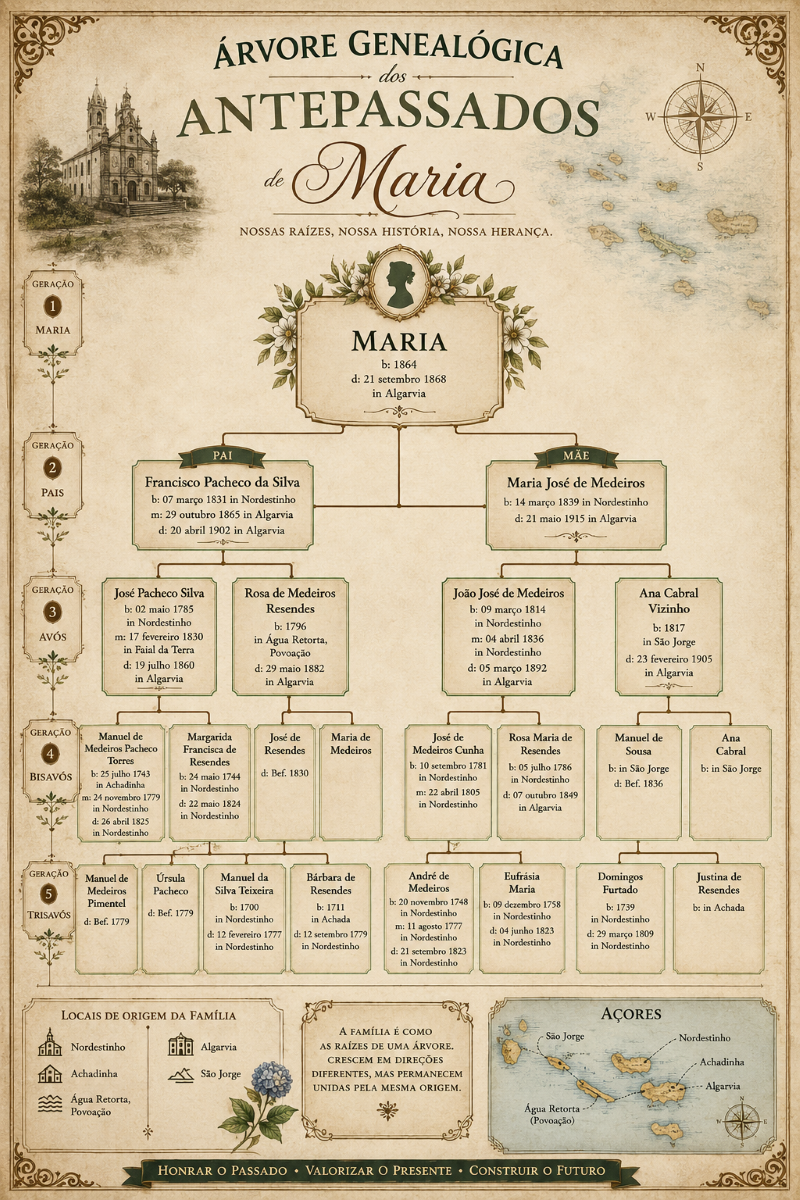
Fagundes Genealogy can help interpret Portuguese names and connect immigrant name variations to original records in Portugal and the Azores.